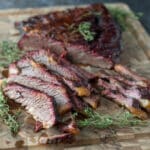
Smoked Beef Brisket
Smoked Beef Brisket is juicy, tender but chewy and a whole lot easier than folks lead on. Learn all about smoking the best beef brisket with minimal effort.
Servings 16 servings
Calories 353kcal
Cost $50
Ingredients
- 8 pound beef brisket
- 1 tablespoon Kosher Salt
- 1 tablespoon cracked black pepper
- 1 tablespoon garlic, granulated
Instructions
- Trim the brisket. Place the meat point side down on a cutting board. Remove silver skin and any excess pocket of fat.8 pound beef brisket
- Flip it over and remove excess fat from the point side. Trim the fat cap to about ¼ inch thick.
- Generously salt the meat on both sides. Place on rimmed baking sheet.
- Refrigerate 12-24 hours, uncovered.
- When you are ready to smoke. Remove the meat from the fridge. Mix the rub ingredients together well. Sprinkle on generously and rub into meat.1 tablespoon Kosher Salt, 1 tablespoon cracked black pepper, 1 tablespoon garlic, granulated
- Set up your pellet smoker, charcoal smoker or electric smoker. Heat to 225°F. We like to use fruit wood like, apple or cherry but you can use hickory, oak, or mesquite too.
- Once smoker has come to temp, place the meat on a rack in the smoker. Either side up is fine. We generally place the fat cap up.
- Place the probe thermometer in the meat, if your smoker has one. Smoke until internal temperature reaches 165°F.
- Roll out a large piece of aluminum foil, butcher paper or parchment paper on a large work surface. Wrap the roast like a package.
- Return the brisket to the smoker, seam side down.
- Continue cooking until internal temperature reaches 200 to 205°F.
- Very important! Let meat rest a minimum of 30 minutes up to 2 hours.
- Separate the flat from the point (the grain of the meat is opposite in the two muscles). Slice both parts against the grain with a sharp knife into ¼ to ½ inch slices.
Notes
WHAT WOOD TO USE
Depending on what type of smoker you have, we like to use cherry or apple wood or pellets. If you don’t have access to those you can use hickory, mesquite or oak but we prefer the sweeter flavor of the fruit.THE STALL
Somewhere between 160°F and 175°F your brisket will undergo what is referred to as the stall. This is a time period that can actually be a couple hours long, where the internal temperature of the meat doesn’t climb as you would expect it to.THE WRAP
The stall is the time when you should wrap the meat. This is referred to as a Texas crutch. This will speed up the period of the stall. By this time, the meat should have developed a nice bark. Typically you wrap the meat in pink butcher paper, or tin foil. We have found that parchment paper works just as well as butcher paper and then you don’t lose the smoke flavor like you would with foil. Also, we don’t have to store a extra huge roll of paper. It would nice if we could give you an exact cook time but there are too many factors involved, including; the size of the roast, the variation in the temperature of smokers, how many times you open the door or raise the lid, and the individual cut of meat itself.Nutrition
Calories: 353kcal | Carbohydrates: 1g | Protein: 47g | Fat: 17g | Saturated Fat: 6g | Polyunsaturated Fat: 1g | Monounsaturated Fat: 8g | Cholesterol: 141mg | Sodium: 615mg | Potassium: 756mg | Fiber: 1g | Sugar: 1g | Vitamin A: 2IU | Vitamin C: 1mg | Calcium: 14mg | Iron: 4mg